


How Gen X and Older Millennials Were Lied To About Bachelor's Degrees

We Were Promised Shangri La, But Became Decades-Long Debtors Instead!

I remember a time, pre-9/11, when if you didn't go to college, you were consider a loser destined to flush his or her future career prospects down the toilet. It was touted from the rooftops that bachelors degrees were the key to sustained career success. HS guidance counselors would desperately warn those who shunned college about their dire fate without the Holy Grail - the Bachelor's Degree! If you didn't go to college and get a bachelor's degree, you career options would be working for The Gap, fast food restaurants, or as a car mechanic. My good HS buddy, Manny, was a college dropout and consistently lamented being a "grease monkey". On campus, all us hot shot students were gassed up by professors as to "how special we are". Prognosticators primed our young and educated class to take over the world upon graduation. It was our time to lead and prosper! Then, reality smacked us in the face and left a handprint on our collective egos.

We were shocked to find that we had to compete with hundreds of other equally "special" generational peers with bachelor's degrees per each job posting.
We discovered our pricey marketing degrees were only useful as an expensive pathway to whack-ass, commission-only sales jobs. We couldn't believe our communications degrees didn't part the Red Sea into media for us. Instead, it gave us the privilege of being a lowly, glorified gofer on-set. What? Employers outside of academia aren't impressed by my philosophy degree? Depressingly, we slinked into banal, entry-level jobs as the low man-on-the-totem pole that was our true fates. Next, the Great Recession, automation, globalization, and a global pandemic robbed us of our promised career trajectories, savings, and ultimately the dreams from our halcyon days. One thing was certain, those student loan payments came in as consistent as the ocean waves breaking on the beach - regardless of your employment status. Here are 4 revealing Reality Checks that we learned regarding the alleged job stability and financial freedom promised to our generation if we earned bachelor's degrees.

The Fallacy of Guaranteed Employment
For years, the message was clear: a bachelor's degree guarantees stable employment. Educational institutions led students to believe that a degree would protect them from the uncertainties of the job market.
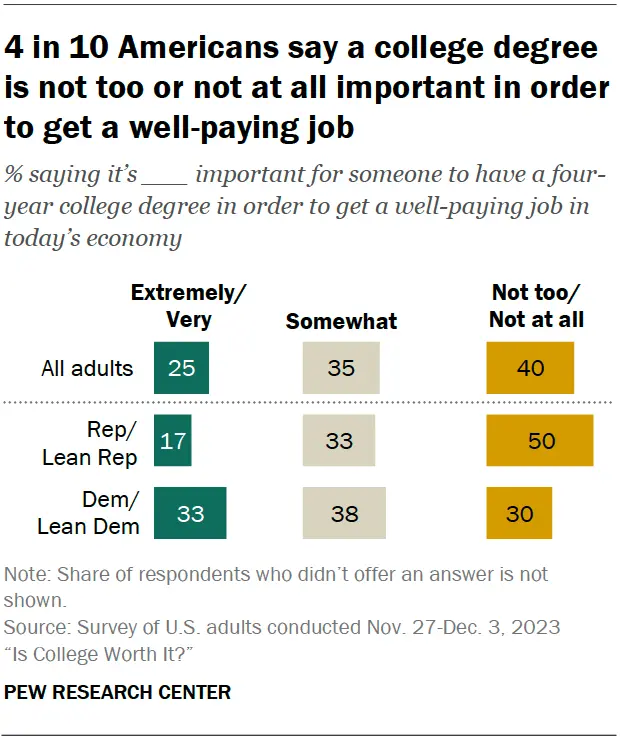
Reality paints a different picture. According to the City and County of San Francisco Department of Human Resources, it's easier to find consistent and stable work in the trades and technical careers. Furthermore, the shortage of workers is forcing higher wages in the skilled trades. Per the U.S. Department of Education, PBS, and NPR reports, people with career and technical educations are also more likely to be employed than their counterparts with academic credentials and significantly more likely to be working in their fields of study. After decades of falling wages, young U.S. workers (ages 25 to 34) without a bachelor’s degree have seen their earnings increase over the past 10 years. Their overall wealth has gone up too, and fewer are living in poverty today.
Simply having a degree is not enough to secure a desirable job today. For instance, as of 2023, 54% of college graduates are employed in positions that do not require a degree, according to a report by the Federal Reserve.
Many degree-holders find themselves in low-paying jobs, leading to widespread disillusionment among those who thought education would pave a straightforward path to prosperity. This shift has left countless graduates feeling trapped and frustrated.

The Myth of Rising Earnings
Another enticing promise made to graduates was the expectation of steady salary increases during their careers. Conventional wisdom suggested that obtaining higher education would lead to better financial prospects.
Wages have stagnated since the 1990's, meaning real wages when adjusted for inflation and cost of living, have grown minimally or even decreased. Most wage gains go to higher earners - which typically don't get realized to mid-career or later. (Economic Policy Institute, 2015)
Even many entry-level salaries have stagnated in recent years. For instance, the median starting salary for college graduates was approximately $50,000 in 2019, but inflation and paying off student loans has significantly harmed the standard of livng for many college graduates.
Current data shows that 43% of graduates report regretting their degree due to the overwhelming debt they face.

The Illusion of Constant Demand
The notion that possessing a bachelor's degree guarantees job demand has proven to be misleading. Rapid advancements in technology and evolving consumer preferences have significantly impacted the job market.
Automation, crowdsourcing, and corporate mergers have displaced many traditional roles. The World Economic Forum predicts that by 2025, over 85 million jobs worldwide may be lost due to automation. With 50% of jobs at risk of automation according to McKinsey, degree holders are left navigating an uncertain job landscape.
Thus, the belief in stable job demands has given way to a harsh reality, forcing many graduates to adapt quickly to keep pace with changing job requirements - and abandon their youthful ambitions in hopes of achieving pragmatic stability.

The Dream of a Secure Future
Many in Generation X and older Millennials envisioned stable careers, suburban homes with white picket fences, and siring 2.5 kids with a beloved partner. After working honorably for decades, we could retiring with a pension, a gold watch, a fancy retirement party, and a swingers cruise around the world. Ok, maybe not a swingers cruise, but a lengthy Royal Caribbean adventure in our golden years. However, many middle aged workers find this dream increasingly elusive.
The decline of traditional pensions and the rise of gig economies have left many feeling financially vulnerable. As of 2021, around 45% of Americans have no retirement savings, illustrating a significant departure from past expectations.
The long-held belief that consistent work would guarantee a comfortable retirement is being replaced by ongoing financial struggles.
Many Gen-Xers and older Millennials fear working until their Social Security maximum cash out birthday, or even well into their 70's!

A Generation Resilient
What does the future hold for Generation X and older Millennials? Despite the shattered dreams associated with education and career success, these generations show remarkable resilience. Many are turning to entrepreneurship, pursuing ongoing education, supplementing income with gig or part-time jobs, or making other drastic career shifts to recover their hopes.
Adapting, Entrepreneurship, and Discovering Multiple Revenue Streams is The Answer
The misconceptions surrounding the value of a bachelor’s degree have made many question their pathways to success. The belief that a degree guarantees lifelong stability has diminished, revealing vulnerabilities in the job market.
Even with these broken promises, there's potential for a brighter future.
Entrepreneurship, experimenting with minimalist lifestyles or combining resources with multi-generational family living, and relocating to cheaper cities (or countries even) to adapt can open doors to new possibilities. Others are renting out their homes, focusing on investments, and perform short term projects to meet ends meat.
Those who have felt let down must remember that higher education did not lead to promised job stability, a prosperous career, or financial freedom; new opportunities await for those ready to embrace change.
One adage remains true..."If something is good to be true, it probably is!"
Too bad it cost many of us $100,000 to figure that out!


Comments